September 26, 2014

9/10/14 - Pendleton Round-Up

Can you believe?  George had never gone to a rodeo! When I found out that the dates for the RWSP association annual meeting synced up with those of the Pendleton Round-Up, I suggested that it be included as a special activity. I would have even coordinated it and booked the tickets for everyone...

No one seemed interested, but I still was.  (After all, George had never gone to a rodeo.)  Their meeting started on Thursday, so I made reservations to arrive at the RV resort on Monday. Wednesday was the first day of the Round-Up--and also Seniors' Day--so I got discounted tickets for two to the rodeo and the BBQ.  

So, as they say at the Round-Up... 
The Pendleton Round-Up is one of the 10 biggest rodeos in the world.  The arena isn't dirt like most rodeos, but grass.  And it's huge--longer than the length of a football field! It makes it a little more interesting (and whole lot less dusty!)  We sat directly across from the Bucking Chutes and watched the count-down on the scoreboard.
The Round-Up starts with a run in on horseback by the flag bearers, and then the Round-Up Queen and her Court charge in, make two jumps, then race around the track. Talk about making an entrance!
 
They started off with bareback bronc event.  These horses were scary, and the riders never stopped flopping.  After 8 seconds of the wildest ride I've ever seen, if the rider's not bucked off, pickup cowboys have to make sure he gets off safely.  Sometimes that's a bit tricky.  Even after the rider is off, they have to chase down the horse to get him out of the way.  (The brown horse in the last photo didn't fall; he made a really fast turn in the grass and then launched himself.)
 
The Indian Relay was run in two heats.  There were three teams of young Indians and nine horses. Saddles aren't included.  They start standing next to a horse, jump up on it and race around the track. When they get around the track once, they jump off and attempt to jump onto the second horse. By this time, that horse is all excited from the noise, so he's jumping around too.  IF the rider gets up, he has to race around again, then swap horses once more. One horse ran across the infield, but I don't think shortcuts are allowed.  
 
Next event was steer wrestling.  Not only does the cowboy have to chase down a steer, but then he has to jump off his horse and flip that critter to the ground and tie him so he can't get up.  Not everyone succeeded.  Those who did were able to do it in less than 10 seconds!
 
 
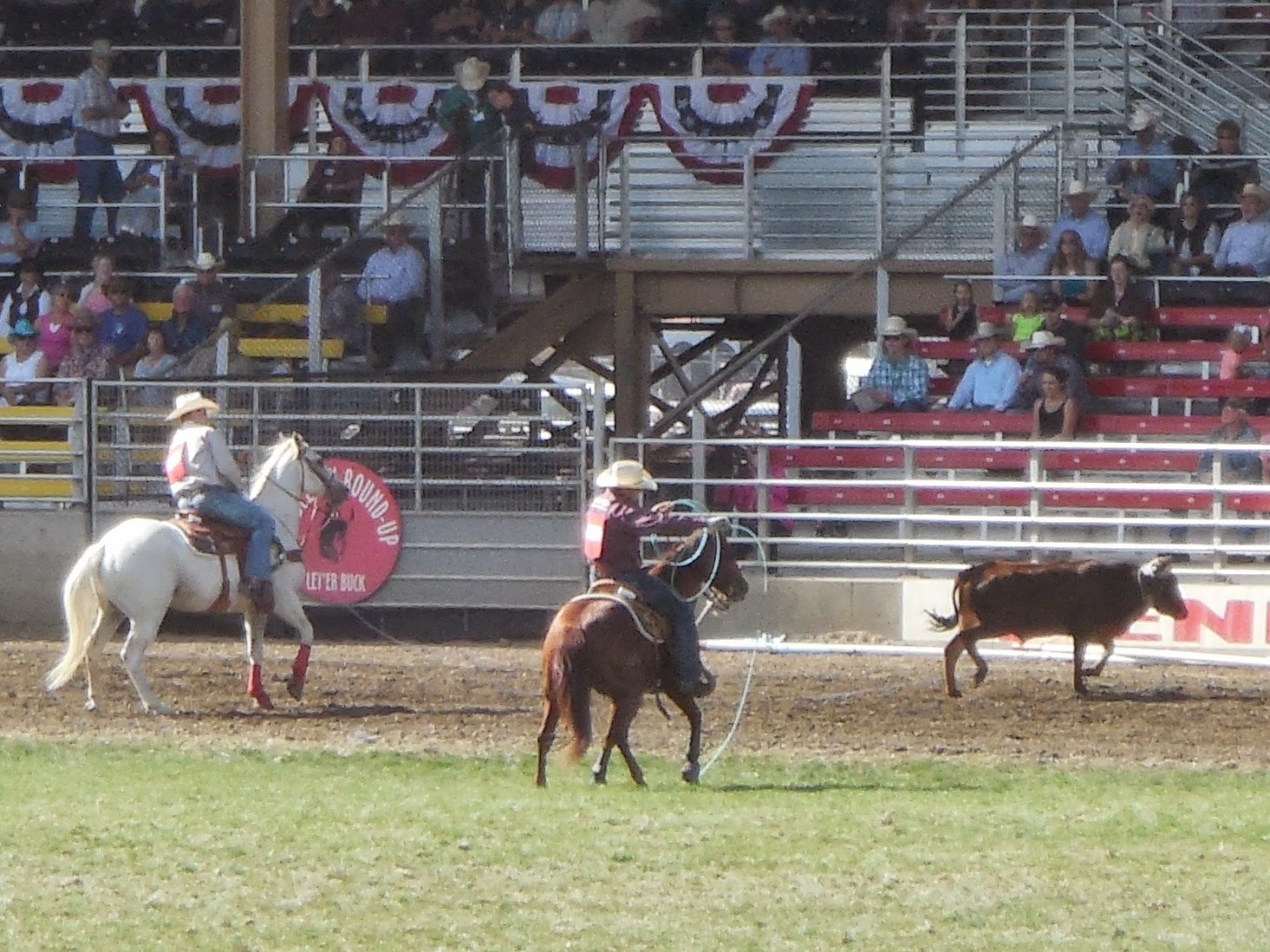
I'd never seen team roping before.  Two cowboys race off after a steer.  One ropes his head and the other somehow manages to rope his back feet.  I think it sounds really hard, and it looks even worse. Only a couple of teams even managed to do it.  (And these are professional rodeo cowboys!)
Then it was time for the bull-riding event.  Scary animals, these bulls.  And they don't like anyone on their backs, even for a measly 8 seconds.  They made the area smaller so the bulls couldn't run all over the whole arena.  I'd never have believed that PVC pipe would have kept a bull contained. Obviously the cowboys sitting next to the fence trust it.  The guys inside with the bull have to jump out of the way.
The Indian Show not only had a dance competition but also a Parade of the Chiefs, all in full regalia. The young men were a constant motion during the dance.  The women and younger kids sort of stayed out of their way while they moved gracefully around a big circle.  A good time was had by all.
 
Steer roping is similar to team roping, except it's just one cowboy.  He has to chase the steer, rope him, trip him, then tie him.  His horse has to keep the rope taut once the steer is roped.  In the top photo, the steer has been roped, and the cowboy is getting ready to put the slack in the rope around the steer's hips to unbalance him and make him fall down.
Barrel Racing is a women-only event.  They have to race around 3 barrels in a cloverleaf pattern. At most rodeos they do this in the center of the arena, but here they place the barrels on the track, one on each side of the mid-point of the long section, and one at the far end.  They really fly as they race across the big infield.  Wow!
 
The last event was the Wild Cow Milking Contest.  Two cowboys vs. one cow.  One guy roped it, then tried to hold it while the other tried to milk it.  I don't think they had to get enough for a bowl of cereal, and to be honest, I never did see anyone actually do it. It was pretty chaotic.
After the crowd cleared, they set up the BBQ down on the grass.  You just needed to be a bit careful about where you walked. There's more than one reason cowboys wear boots!  I think George enjoyed it--I know I did.  It would be nice if they'd include it in the itinerary for the meeting next year.  (My offer to organize it still holds, guys.)

Click the link for more pictures of Pendleton Round-Up

September 24, 2014

9/10/14 - Whitman Mission NHS

Whitman Mission National Historic Site is near Walla Walla, Washington--which is great fun to say! (Walla-Walla-WASH-ing-ton!)   We didn't stay very long--just long enough for George to get his passport stamps and a quick trip through the museum--so this will be a short post.


The site tells of the events at Waiilatpu from 1836, when Marcus and Narcissa Whitman established their mission, details of the tragic misunderstanding and "massacre" by the Cayuse Indians after a measles epidemic, up to 1846 when Oregon became an official territory of the US.  
Our timing was really bad.  We got in on the last 20 seconds of the video before the credits started rolling.  Ranger programs end after Labor Day weekend--two days ago. We had to be in Pendleton in less than an hour.
There's a museum in the Visitor Center.  This is my favorite exhibit:
Some interesting "firsts":
  • Marcus and Narcissa Whitman were the first Protestant missionaries to the Northwest (along with fellow missionaries William Gray and Henry and Eliza Spalding)
  • Narcissa and Eliza were the first white women to cross the Rocky Mountains
  • Whitman and Spalding printed the first books published in the Pacific Northwest--
  • After a trip back east in 1843, Whitman led the first wagon train to the Columbia River on what became the Oregon Trail 
A (very) few more pictures here:  Whitman Mission Natl Historic Site

September 22, 2014

9/5/14 - Oregon Trail Interpretive Center

I’d picked up a brochure about the National Historic Oregon Trail Interpretive Center near Baker City, OR.  Since that’s where we were camping this week, it seemed like a good idea to check it out...after lunch in Baker City at York’s Covered Wagon, a rather unique deli/sporting goods store.  We ate outside next to the World’s Largest Map of the Oregon Trail.

Then it was five miles to the Interpretive Center on Flagstaff Hill. 

Sister to the National Historic Trails Interpretive Center in Casper we visited last month, it’s another BLM interpretive center, which means it’s more a learning experience than just museum collections.  I never did figure out what the shape of the Visitor Center was supposed to represent.  Often it symbolizes something about the park, and usually you can tell...
There’s lots of life-size dioramas.  And these are not your parents’ dioramas.  They’ve actually used taxidermy animals so they look real because they were real.  (Except for the people, of course.)  As you can see, the guy with the camera is George, so he looks more real than the guy on the horse.  The oxen--being stuffed--look even better. 
 
One section of the floor is made to look (and feel) exactly like the trail the pioneers walked on, like dried-out mud complete with wagon ruts and footprints.
In the next area of the museum, there are exhibits that show what choices the people had to make at different stages of the route.  Even before they started, they had to decide what to take and what to leave behind.  It was pretty obvious that the piano had to stay, but it would be hard for me to leave books.  The list of staples they had to take surprised me.  I know that sometimes they ate venison and buffalo (and ox), but they wouldn’t have been able to take the leftovers with them in freezer.  (Once again, I’m really glad I was born in the 20th century!  I am such a wimp.)
 
See the little doors with handles in the picture below?  In many of the exhibits they detail some of the decisions the emigrants had to make, then you lift up the little door to see if you would have made the right choice.  Sometimes the choices determined whether the travelers would have lived or died, or maybe just had a really miserable time.  In this exhibit about South Pass, they had to choose which trail to take:  Oregon Trail to the Pacific Northwest; Mormon Trail to the Salt Lake valley; California Trail to the Gold Rush; various cut-offs that were supposedly short cuts but didn't always work out--or even to turn back and go home (not a good option!)
If you look outside and down the hill, you can still see the ruts the wagon wheels left during the migration.  It’s been 150 years and they still show as scars in the landscape. They're kind of hard to see, and not where I thought they were...
Outside there’s a circle of wagons they call it a “wagon encampment”.  Some are replicas, but the one by itself was built in 1880, and it was used on the Oregon Trail.  Sometimes they do demonstrations on weekends.  Kids love 'em!
 
There’s a trail out the backdoor of the museum down to the wagon ruts.  Although it’s paved, it’s a 2 mile trip downhill, then 2 miles back uphill.  (Really?  It's 80 degrees out here. Oh, come now...Besides, George outvoted me.)
I had an alternate plan.  We drove downhill 1/2 mile, stopped at a historical marker pullout, then walked about 180’ to the ruts.  
In this section of the trail, because there was room to spread out, there are three sets of ruts, but most of the time two are very difficult to identify.  Cars leave 2 parallel tracks from the wheels; wagons leave the same 2 parallel tracks, and a trench in the middle where the oxen hooves packed down the earth, so it can be harder to identify.  It helps when BLM posts markers.   Sometimes you’re just not sure, even if there are signs.
 
 
Then it was back to Baker City to head to our own version of a covered wagon.  Emigrants, eat your hearts out!

To view more pictures, click here:  Natl Historic Oregon Trail Interpretive Center