March 31, 2011

3/29/11 & 3/31/11 – Jean Lafitte NHP&P

Like John Day Fossil Beds, Jean Lafitte National Historic Park & Preserve is another park that’s comprised of various sites scattered all over the place.  Each one has a different theme--that should probably be focus—but we are, after all, discussing a park.  I’m not entirely sure why the park service decided to name a park after a pirate, but maybe politicians felt a certain connection??
There are 6 Visitor Centers in southern Louisiana.  We visited 3 of them:  Acadian Cultural Center in Lafayette, Chalmette Battlefield and National Cemetery in Chalmette and Barataria Preserve near Marrero.
3/29/11 - Acadian Cultural Center:  We wandered around the museum looking at exhibits on the Acadian culture until time for the next showing of the movie about how the Acadians from the Canadian Maritimes came to be Cajuns in Mississippi.  (Blame the British!)  Then we headed to Breaux Bridge.  (Note:  I’m doing a separate blog for the Cajun Swamp Tour.)
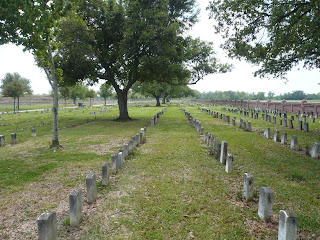
3/31/11 – Chalmette:  Chalmette Battlefield was the site of the Battle of New Orleans in 1815, and the Chalmette National Cemetery has over 15,000 graves of veterans from the Civil to Vietnam wars.  We used the GPS and ended up at the cemetery but couldn’t figure out where to park.  A ranger explained to us where the Visitor Center was, let us drive through on a maintenance road.  We came in from the wrong end of the road, but headed to the Visitor Center.  We checked out the exhibits, then watched the video about the battle.  We learned a whole lot more about the importance of the battle there than we did in High School!  There’s a self-guided tour that goes all around the battlefield, so we hopped in the truck and went back to see the American ramparts and cannon.  The US cannons are/were painted in US regulation colors:  sky blue and black.  I guess if the British are wearing red coats, then painting the canons light blue fits right in.  Only one canon was black (actually Spanish red and black)—a 32 pounder that had been commandeered from a Navy ship. 

We saw the battlefield from both the American and the British side.  Not as large as you’d think—and yet it is. On one side is the Mississippi.  The field is really swampy and the day we were there it had standing water in several places.  Must have been a terrible place to have to cross.  I’ve still got chunks of the song in my head…let me know if you can remember more than the first verse, the chorus—and of course, the part about the gator!

The cemetery location was part of the battlefield.  It was established as a burial place for Union soldiers who died in the Gulf area during the Civil War.  Only 4 soldiers from the Battle of New Orleans are buried there.  It’s a quiet peaceful place.
 3/31/11 – Barataria Preserve.   George really got into Chalmette, and I had to remind him that we still had another place to go.  From the park, we drove to the Chalmette Ferry—right next to a big refinery—to cross the Mississippi.  Obviously we Washingtonians know ferries—this was definitely not the Puyallup!  I told my son that we rode backwards across the Mississippi and he wrote back “Don't you know that you cross the Mason-Dixie timeline when you cross the Mississippi backwards and screw up the space-time continuum and could reverse the entire Civil War and those Damn Yankees could actually LOSE if you keep that up?"  So let me explain about the Chalmette ferry: unlike Washington ferries, where you drive on one end and drive off the other end when it docks, this little ferry only goes one direction. You drive on and loop around like a u-turn, and get off on the same end you drove in on. There were enough other cars in front of us that we didn't get to the loop end and that's why we rode backwards!
When we got to the Visitor Center at Barataria, the ranger explained that we had to be out of the park by 5:00 pm or we’d be locked in!  Since George didn’t want to park outside the gates alongside the road, we had to scurry to get down to the Alligator Marsh and back again.  The trail goes through the forest, then on boardwalks through the swamps and marshes.  We did see a couple of alligators, and some turtles and lizards.  We saw just a few Giant Blue Iris in bloom—but there are areas where there are huge fields of them.  Sure would be nice if we could time our trips with the local wildflower bloom time better.

We went back to the RV park (located on the “northshore of New Orleans”—that means the north side of Lake Pontchartrain), going over the Huey Long bridge, through parts of New Orleans, then crossing the 23-mile causeway across the lake.  It’s the longest bridge in the US, and I thought it would be more interesting…but it’s kind of boring, not much to see but water and the cars in front of you.  There are 2 drawbridges and lots of call boxes.  Eventually (yawn) we made it across, then struggled with rush-hour traffic through Covington.
There are three other sites for Jean Lafitte that we didn’t visit—but we will next time!  French Quarter Visitor Center in New Orleans, Prairie Acadian Cultural Center in Eunice and Wetlands Acadian Cultural Center in Thibodaux.

3/29/11 – Cajun Swamp Boat Tour

When we checked in at the RV park in Broussard, the manager suggested Bryan Champagne’s Cajun Swamp Boat Tours were the best in the area.  I called early the next morning and got reservations for the 1:00 pm tour.  Yahoo!  I’ve wanted to take a swamp tour forever!
After we’d explored the Arcadian Museum at Lafayette, we headed to Breaux Bridge and drove out of town to Lake Martin Landing.


The sign was on the boat trailer, so we knew we were at the right place.  I’ve totally spaced on the name of our tour guide, but he was a really nice guy.    The boat was an aluminum crawfish skiff--with an “mud runner” motor.
We headed out onto Lake Martin into a flooded forest of Cypress and Topulo trees draped with spanish moss.  The lake averages about 8 feet deep, but it’s a pretty big lake. We learned the difference between a swamp and a bayou. 

 
There were 14 of us in the boat plus our guide.  Four of them were children; three of the children were well-mannered and one was obnoxious.  The obnoxious one sat next to George who was a master in self-control, muttering what he thought only to me.  The kid didn’t want to be there, and kept pushing to go back to the car.  Before the tour was over, I think most of us were considering tossing him to the gators.  Lots of looks exchanged between the rest of us made that pretty clear.

We went slowly through the swamp, with the guide pointing out birds:  several types of Herons and Egrets, Anhinga, pink Roseate Spoonbills.  There’s a bird sanctuary on Lake Martin, and right now it’s nesting season so there was a big section of the lake that was protected and we couldn’t go through it. 
He showed us duck blinds.  Some were pretty exotic, with “garages” for the boats, some were pretty basic, and some even looked exactly like old cypress stumps.  One old one was just a 55 gallon barrel hung up on a tree—he said they don’t use that kind anymore.


And, of course, he pointed out alligators!  Little ones, big ones, gators resting on logs and some swimming (usually away from us).  He’s Cajun, and an alligator hunter, so he had lots of info on those reptiles.  He’d stop if there was something interesting to see and go back if we wanted to see something again.
 Long, slow, fun, informative tour.  Go here for more pictures:  Cajun Swamp Tour 

March 22, 2011

3/22/11 – Big Thicket NP

Big Thicket was the first designated National Preserve in the country. It's sort of spread all over east Texas—there are 4 land and 4 water units. We went to the Turkey Creek Unit, which is where the Visitor Center and HQ are. 

We hadn't planned on going to this park, but we're staying at 1000 Trails Lake Conroe north of Houston. We picked this resort to visit George's cousin Wally's family, then extended for another week so we could make sure we got some mail my daughter is forwarding. While we're here, we looked at the book on national parks to see if there was anything around close. It's not exactly close—80 miles or so.

After the initial stop to take pictures of the sign, my first stop was the restroom. (Both of these are SOP—George is used to this by now!) No lights inside the ladies' room. Hmmm… George came out of the men's room—no lights there either. We took turns holding the outside door open enough to see inside. Then one of the rangers came out to start the generator out back—turned out there had just been a power outage because of the high winds. (I think "high winds" is a definition of Texas, but maybe it's just spring.) 
We saw the park movie, then prowled around the exhibits. The ranger gave us a map of the Kirby Nature Trail and sent us on our way. The front of this Visitor Center is really welcoming, with big rockers lined up just asking you to sit and stay awhile.


We ate lunch at a picnic table near the start of the trail, near an old log cabin that's now used for educational programs. Looking at the air conditioner in the window, I wondered if the original settlers would have left if that had been there…


The trail is 1½ miles, winding through (and I'm quoting the brochure here) "forested slopes, acidic baygalls, flood plains, and cypress sloughs". You pick up a self-guiding booklet when you register at the trailhead. There are numbers on the trail, and the booklet has something for each number—even though it might not make any sense at all to what you're looking at. One of the stops was for "crawfish chimneys” —nothing to see there, but George found some after we left the park—so I took pictures.  Apparently the crawfish burrow down into the mud during the winter, and the little mud pellets are brought to the surface so they can live in water underground.
 We were too early to see the magnolias in bloom, but violets, hydrangeas and azaleas were out. Dogwood too, but not so much along the hike—just the roads.  


It's a nature trail—I took pictures of flowers, trees, fungi, cypress trees & knees. Mostly I don't know what they are. Just look at the pictures and enjoy…

Link to pictures of Big Thicket NP