May 30, 2015

5/21/15 - Lincoln Home NHS

Another state, another President's house.  This time it's the Lincoln Home National Historic Site in Springfield, Missouri. The house is one he bought and actually lived in as an adult with his family, and there's a lot of furniture that the Lincolns owned. It doesn't cost anything to tour the home, but you do have to pay $2 an hour for parking. (George was a bit miffed about that.)  I think it's a national park, but a city parking lot.

They give out free tickets in the Visitors Center but they're timed because they only take 15 people at a time. Fifteen might be pushing it a bit. We didn't have time before the tour to watch the movie, but we went back later.

Besides the Lincoln Home, the park consists of a neighborhood of four blocks with several of the houses restored to their 1860 appearance.
 This is a really famous angle for photos of the house.  There's one like it taken in the summer of 1860, with Abraham Lincoln and his son Willie standing behind the fence. Now it's just tourists.
We met the Ranger tour guide in front of the house where he ran through the rules. (Don't go beyond the barriers, don't touch anything, don't lag behind. Reminds me of things I used to tell my son when we took him places when he was little.) 
When we got inside, he did a good job of telling anecdotes about the Lincolns, a little history of the house, and keeping us moving.
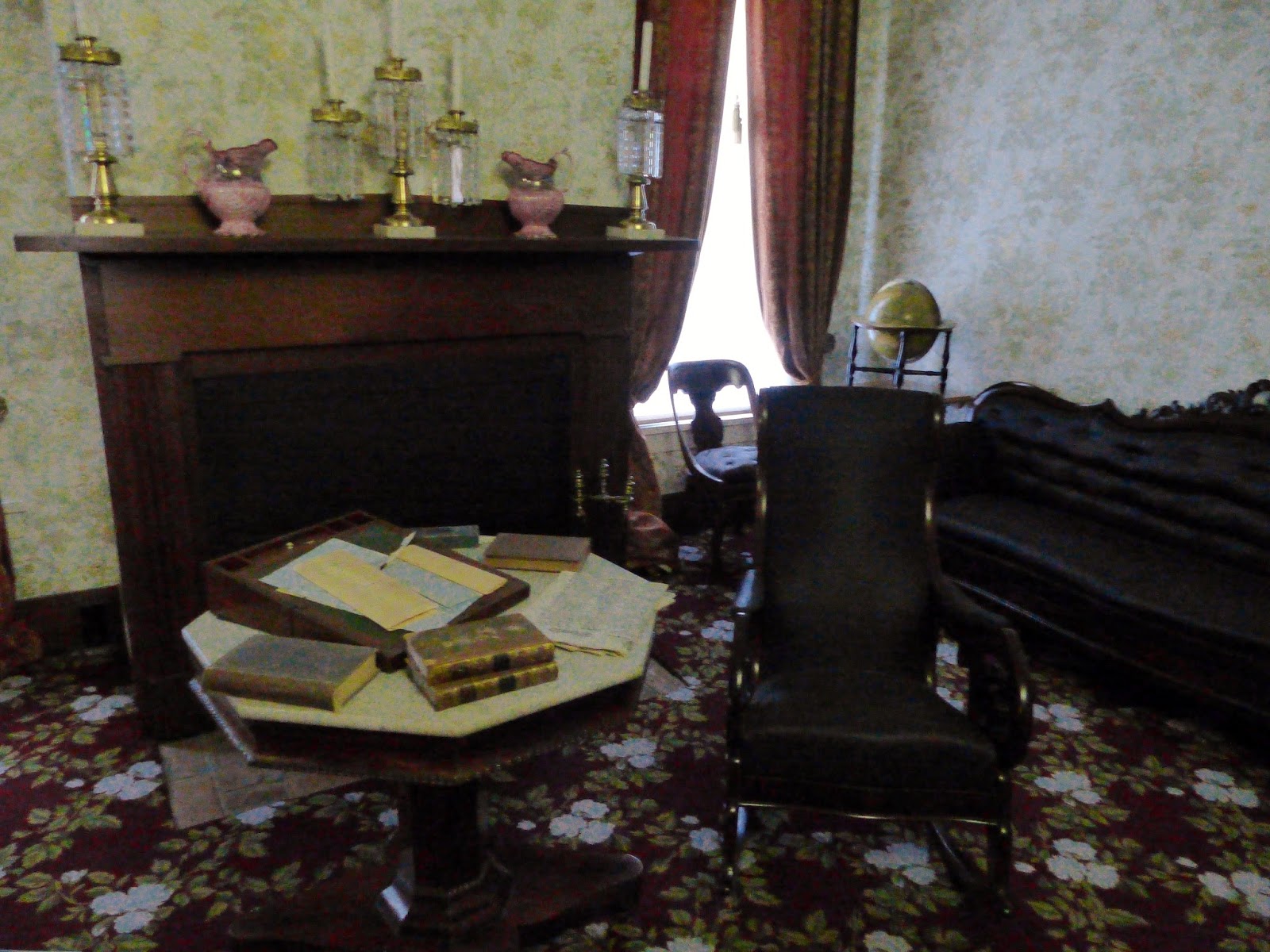
The Sitting Room looks like a very busy room to me, with the patterns squabbling for dominance. The Ranger told us that the colors and patterns were typical 19th century--the theme is "Nature" and Nature isn't quiet. It's not quite so bad here, but wait till we get to the bedrooms!
This is the bedroom the Lincoln boys used. There's one of these little stoves at each end of the room.
This is Mr. Lincoln's bedroom. Doesn't look it, but the bed is longer than a California King. The desk he used looks more like it would fit his wife. And there's that pattern thing again.
Apparently it was common 150 years ago for husband and wife to have separate bedrooms. Mary Todd Lincoln's is just beyond. Same rug, same wallpaper, different bed. (And until the oldest boy went away to school, the two younger boys slept in her room. That must have been lovely.)
Here's the boys' room. Please note plain walls and a simple striped rug. Bedspread looks like wallpaper.
The hired girl slept in this little room off the kitchen. 
Mrs. Lincoln liked the stove in the kitchen so much she wanted to take it to the White House. Mr. Lincoln convinced her that they would have stoves in Washington, DC. 

After the tour, after the rest of the group drifted away, George and I hung around in the backyard talking to the Ranger. This seems to be becoming a habit. Pretty cool when you can find out a little more about the people at the parks, and learn a little more than is in the standard tour.
There are a few more pictures, but not many. It's difficult when you have to shoot around people and their children who keep moving into your picture. I'm used to George doing it, but this is trickier. Click here: Lincoln Home NHS 

May 29, 2015

5/19/15 - Ulysses S Grant NHS

The Ulysses S Grant National Historic Site is southwest of St. Louis. Our always reliable GPS took us just past the official historic site entrance and into Grant's Farm--which we'd never heard of. (If I'd heard of it, I might have included it in our itinerary for the day. It used to be part of the Grant farm, then it was the Busch family estate, and now it's sort of a zoo and where some of the Busch Clydesdales live. ) 

The Visitor Center doesn't seem to fit for this particular park, especially the color. (The building off to the left is the old barn, which now houses the museum. It's a much better color--although I think they should be painted either the same shade or something a little more harmonious since they're next to each other.)
We watched the video, then browsed around in the museum until it was time for the tour of the house. After his graduation from West Point, Ulysses S Grant was assigned to a regiment stationed at Jefferson Barracks, south of St. Louis. While there, he met and courted Julia Dent, whose father owned this house and more than 30 slaves. Ohio-born Grant came from a free state, and his family was against slavery. You wouldn't think that a couple whose families were at opposite ends of the political spectrum would be able to build a relationship, but they managed to build a strong one.
When it was time for the tour, we went out back to the house named "White Haven" originally owned by Julia's father. (Grant ended up buying it from him after the War.) The Ranger tour guide talked to us out front for a bit before we went inside. Even after seeing the paint job on the Visitor Center, I wasn't prepared for the color of the house! I asked who chose the paint, and he assured us that it was the exact shade of a popular 1870s paint color called "Paris Green". Really?  Wouldn't have been my first (second, third or even fourth!) choice...
The Grants furniture didn't make it to the park because it burned in a fire at another building in 1873, so there are a few pieces of furniture representative of the time. Mostly it's pretty empty inside.
 
We went out the back door, and on the left side of the porch is the old Winter Kitchen. Not much there either.
The Summer Kitchen isn't connected to the house.
 
The old Ice House is still there--but since they left the door open, there's no ice, of course.
The Chicken House is next to it, and it still smells like chickens. I don't know how long it takes to clear the odor out.
After the tour was over, we stood outside and talked to the Ranger for awhile. He's a really nice guy and very knowledgeable. It always impresses me how much the people who work at the parks research and read on their own time so they can answer any question you throw at them. And they're always so politely neutral when tourists make snarky comments like mine about the paint job on the Visitor Center.

On the way out, there's a reminder of President (then General) Grant's role in the war--a brace of Howitzer cannons.
A few more pictures here:  Ulysses S Grant NHS

May 28, 2015

5/19/15 - Jefferson National Expansion Memorial

I wanted to see the St. Louis Arch. I learned they call it the "Gateway Arch". Then I found out that the official name for the national park it's located in is called Jefferson National Expansion Memorial.  We didn't know that there was construction going on all around until we got to St. Louis, but apparently they're expanding and revamping the whole area around the Arch.

Temporary Visitor Center is in the Old Courthouse. We stood in line to get tickets to ride the tram up into the top of the Arch. The tickets are timed, so we hustled to get around the detours and construction mess. Just follow the arch-arrows on the sidewalk.
This thing is huge--630' high and 630' wide at the bottom! (That's a 192 m equilateral triangle to those of you who prefer metric. I looked it up so you wouldn't have to.) But George wouldn't let me gawk and take pictures because we had to go through airport-like security at the Gateway Arch Visitor Center before we could get on the tram.
Once we got inside, we got our boarding passes, went downstairs. Five of us at a time stood opposite a small doorway--the door is just the small section with numbers. When the tram comes in, the doors open and the people on it get off and go upstairs. You sort of climb into the round pod which has 5 little chairs in it. It's only a 4-minute ride, so you don't get much time to gripe about how uncomfortable it is. They say the pods stay upright when moving, just like ferris wheel seats. (Actually, I'd never considered that they might not. I can do ferris wheels; I can't do the upside down stuff.)
 
 
The inside of the top of the Arch is 65' long and has 16 windows, 8 looking towards St. Louis and 8 looking toward Illinois on the other side of the Mississippi River. There's no time limit so you can wander around and see if the view changes from window to window. (Mostly it doesn't, but you have to be careful aiming the camera because the floor slants unless you're in the exact middle.) You can see the Cardinal's Busch Stadium on the left, and if you knew where to look across the river, you can almost see the campground where we stayed.
 
Back down, there's a museum so you can learn all about westward expansion, but it's closed until next year because of all the construction. Just in case you didn't pay attention in American History class, here's a brief recap: President Thomas Jefferson bought the Louisiana Purchase from France in 1803, then sent Lewis and Clark to check out what he'd bought. They started their trip from St. Louis. They were followed by other explorers, mountain men and trappers, emigrants and soldiers, and lots of them headed west from St. Louis too. Hence, westward expansion.
Outside, we wandered around the Arch, down the Grand Staircase to the riverboats. Would have been nicer without the construction fences and mess.


We headed back to the Old Courthouse. I went upstairs to check out the courtrooms and get a closer look of the dome.
Maybe we'll be able to go back someday when they've finished their improvement project... 
You know the drill--more pictures here:  Jefferson NEM