May 19, 2015

5/7/15 - Strataca

Strataca used to be called the Kansas Underground Salt Museum, which I think was a much better name. I keep trying to call it "Saltaca" or "Stratacata". Even George has trouble remembering its name...and neither of us is quite sure how to pronounce it.


Before you ask, it's #4 on the list of 8 Wonders of Kansas. And just in case you think I'm not serious about the list, I have proof. Check out the sign on the side of the building.
I had no idea there were underground salt mines in Kansas. I would have guessed Death Valley or Utah, but Hutchinson, Kansas? The salt deposit extends across (well, I guess "across" isn't the right word for something underground--how about "below"?) 27,000 square MILES of Kansas. They're still mining nearby, but the museum is in the historical section that was mined last century. Old Engine #2 was built by GE in 1919 (one of only three ever built) was used by Carey Salt Company until 1963.
As we should have expected, there was a group of kids on a field trip (different tour, hooray!) Not much to do in the waiting area while waiting for the tour, so I watched some of the boys at the salt lick. (Lick the finger, touch the rock, repeat. Yuck!) There's an assortment of different chunks of salt rocks, intended for looking and touching, definitely not meant for sampling. 
There's a safety video, then everyone dons a hard-hat and gets squashed into an elevator for the 650' descent to the mine. The guide asked if anyone needed the lights on, and since no one objected, we rode down in the dark, like the miners do. Takes 90 seconds, and it's kinda weird, and very black, but not claustrophobic or scary. I was trying so hard not to bump into someone around me, I didn't think about it. (Sorry, no picture. Use your imagination. Black is black.)

Once down, you're in part of the old mine in a section they call the Permian Room, named after the sea that left all this salt behind when it evaporated. The guides point out the layers of salt in the walls, tell you a bit about how the salt was formed, then let you wander down the giant hallway at your own pace. The salt is the light layers, the dark stuff is very old dried up mud.
The salt isn't pure enough to use for table salt, so is mostly used for roads. Washington isn't in the "Salt Belt" and doesn't use salt on the highways, so I didn't realize how much salt other states use in the winter. Of course, they have more snow than we do, but Seattle has been known to blow it's whole sand budget on one good snow early in the season. Our cars don't rust out on the bottom.
There's a whole salt mining gallery, explaining the history of the Carey Salt Company. Mike Rowe, the host of Discovery Channel's show, Dirty Jobs, did a segment on the mine. This is definitely another job that would have been on the list of jobs I'd never want to do, but it was interesting.
Apparently it's not cost efficient to haul trash back up, so they just stockpile it there. They even have displays of trash. (What goes in the mine, stays in the mine-they don't haul anything except salt and people back up.)
There's another section about secure storage. Underground Vault and Storage uses part of the mines for storing documents and movie film and memorabilia. (Really? Who'd expect to see Batman's costume in a mine? I guess they send a lot of stuff to the salt mine.)
The Salt Mine Express is a 15-minute train ride that goes through a section of the mine active in the 1940s and 50s. The train is cute (it's a hand-me-down from the Hutchinson Zoo). Obviously it was intended for children, so George wasn't very comfortable in it. It was okay for me...
Occasionally one of those skinny layers of salt and mud break off from the ceiling. This was in a side tunnel. The miners keep a close eye on the ceiling to catch any separations before they fall and do real damage.
The Dark Ride is ride on a tram (little bigger--George was happy) through the tunnels, looking at things left behind, learning more about salt mining. It's dark except when the motion sensor lights turn on as we get near.
 
This old car was used to move supplies within a section of the mine after it was converted to electricity. No, it's wasn't like today's electric cars that are plugged in to charge the battery--it was plugged in to an extension cord. They could only drive it as far as the length of the extension cord! Poor ugly little thing.
Near the end of the tour, we stopped next to a couple piles of salt. We got to choose a piece smaller than the palm of our hands as a souvenir. George got a bigger piece 'cause his hand's bigger.
So if you go to Strataca, here's a bit of advice: (1) don't expect good pictures and (2) don't lick the walls.

More pics: Strataca 

May 15, 2015

5/6/15 - Cosmosphere

Kansas Cosmosphere and Space Center in Hutchison, KS, is #3 on the 8 Wonders of Kansas list. It has one of the biggest collections of US and Russian space artifacts in the world. It's in Hutchinson, Kansas, and is affiliated with the Smithsonian. I'd never heard of it...
Upon walking into the building, the first thing I noticed was an enormous black plane. Although it's mounted up high, part of it is still in the way. George knew exactly what it was, a Lockheed SR-71A Blackbird, the infamous spy plane of the Cold War. I found out later that they put the Blackbird on the pedestals, then built the building around it. (Wow! Hope they don't ever have to move.)
This is the back of the SR-71

...and 107 feet later is the front of the Blackbird!


If that's not impressive enough, there's also a T-38 training jet suspended from the ceiling and a full-size scale model of the space shuttle Endeavor. Actually, it's just the left side, but that side is full-size. It's not like they expect it to fly.
When you buy your tickets, you have to decide which of the documentaries you want to watch in the Dome Theater, then you're scheduled for that and the Planetarium and Dr. Goddard's Lab right then. That means you have to pay attention to the time...
The Hall of Space Museum is downstairs. Going down, I was mesmerized by the stained glass memorial to the 17 astronauts whose lives were lost in the Apollo I, Space Shuttle Challenger and Space Shuttle Columbia missions. Really impressive. (Apparently everyone in Kansas can relate better than I could to the Latin phrase--it's Kansas' State Motto, and it's on the Kansas State Seal and even the Kansas license plates.)
It's Field Trip season in Kansas. The Cosmosphere is arranged in little cul-de-sacs, so you can't really get away from the kids when they rocket into the area where you are. I don't think the intention was for them to learn anything; they just blast through like an asteroid, destroying everything in their path. We tried to just stop and get out of their way. One little boy asked George if he was a robot.
In the German Gallery are V-1 and V-2 rockets, demonstrating how their technology made space travel possible. This is a V-2. I couldn't get far enough away to fit the V-1 into a single frame
The galleries are like a maze. I kept losing George and finding more kids. (Don't worry; eventually George found me and we lost all the kids!) The Cold War Gallery has exhibits about the Space Race. They have a flight-ready backup for Sputnik I. (I had no idea they had backups, but it makes sense in case the first one didn't work. It's kind of cute, isn't it?)
They have a Red Thunder, Russian RD-107 rocket engine. (I actually have no idea what that is, but I really like the picture I took of it, sort of abstract with bright colors. Mostly it was hard to take pictures in the museum because of the lighting, but this one worked.)
Around another corner and outside is the Titan Rocket Pit. This is the bottom of the rocket you see on the side of the building as you arrive.
Back inside you go on to the Mollet Early Spaceflight Gallery, where there's a Liberty Bell Mercury Capsule that was flown by Gus Grissom, then recovered from the Atlantic and restored by the Cosmosphere. I thought they were just a museum, but apparently they do a lot of restoration for the Smithsonian's Air and Space Museum, and other museums around the world.
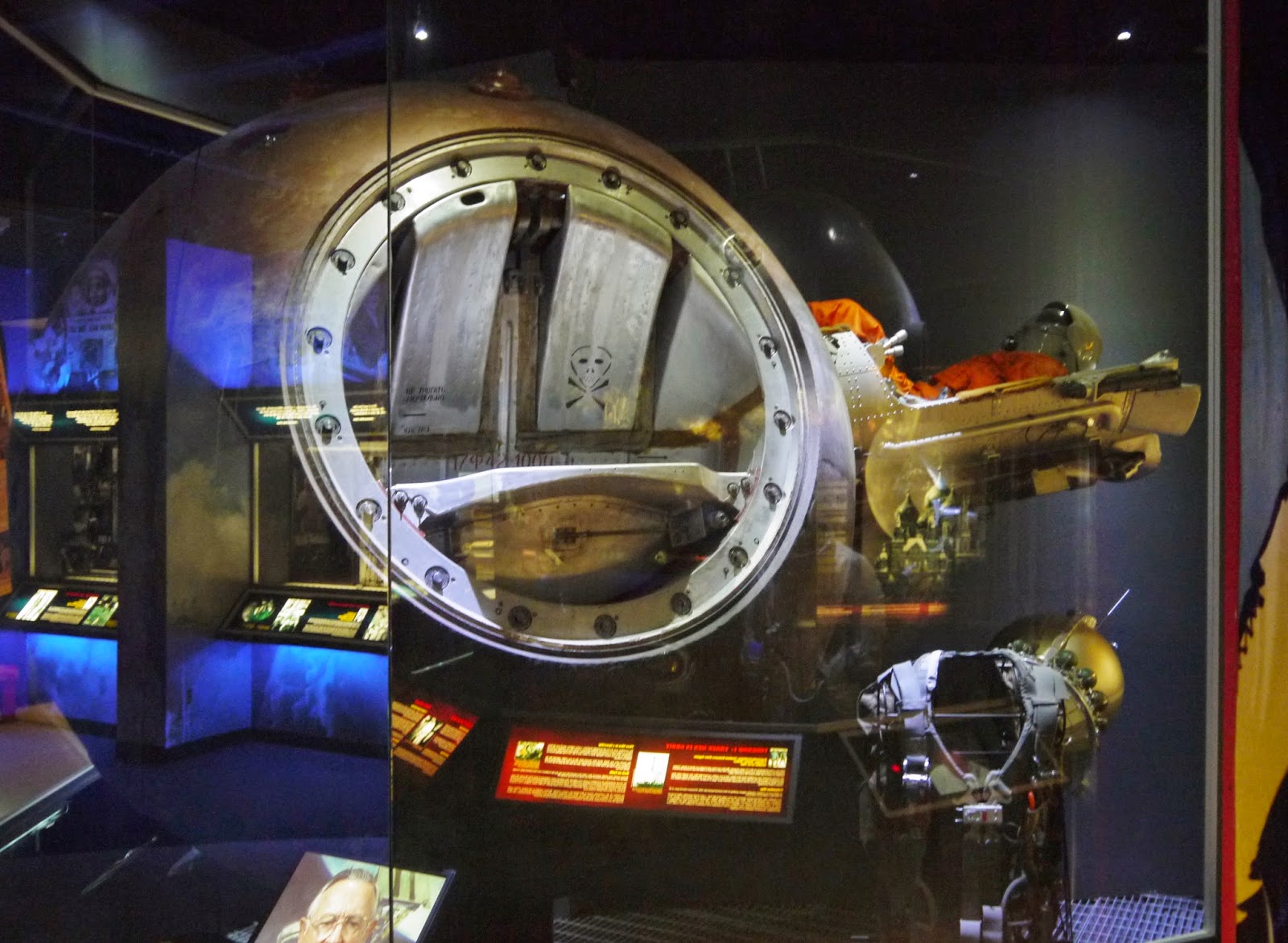
They have one of the few Soviet Vostok Space Capsules in America.
In the Lunar Exploration Gallery is a Lunar Module. (Looks pretty fragile to me. If I were roving around on the moon in zero gravity and zero air, I'd want something a LOT more substantial, I think. Something more along the lines of a lunar tank. I guess that's one more reason I never tried out for the space program.)
The Apollo Gallery is next. The Apollo XIII command module, Odyssey, is here and restored. The story on how they got it and all the pieces--and put it all back together is pretty impressive.
The last gallery downstairs is about the Astronaut Experience. Someplace I read how many space artifacts the Cosmosphere has...something like 15,000. And, like most museums, they only have a tiny percentage exhibited. If you've never seen one, they have a Moon Rock brought home from the first Moon Landing in 1969. (It's not as big as it looks, honest! And it's very ordinary looking, sort of like--you know--just a plain old rock.)


Showtime was upon us, so we headed back upstairs to the main floor.
2:00 PM - Dr. Goddard's Lab, a live show geared more to kids than adults. It was kind of fun though.
3:00 PM - Justice Planetarium. Not quite the planetarium I remembered from when I was a kid. The lights dimmed slowly, the narrator pointed out Venus and Mars, identified a few constellations, then whirled us from dusk to dawn with the night sky spinning above us. Then we watched a movie about Black Holes. (A movie???? Really? I wanted to see a planetarium show. AND I got a stiff neck watching it on the ceiling.) 

4:00 PM - Carey Digital Dome Theater. Weirdest theater I've ever been in. It's truly a dome, and they show the movie on the curved section in front of you. It makes everything strangely contorted, so sometimes what you're seeing is so wrong it doesn't make sense.  (We saw a movie about how the airplane has changed the world; I think I would have liked the space one better.)

Interesting place...in the middle of Kansas. Who knew?

More pictures:  Cosmosphere 

May 11, 2015

5/5/15 - Old Cowtown Museum

Located on 23 acres in Wichita, Kansas, Old Cowtown Museum is a living history museum of a typical Great Plains town from the 1870s. It's a fun way to learn how a famous old western town on the Chisholm Trail managed the move to become a Victorian town on it's way to what is now the largest city in the whole state.
After getting our tickets at the Visitor Center, we were given a map of town, and headed back in time--just like in a Twilight Zone segment. We found when we got there that a bunch of grade school kids had taken over the town. No, wait! It's yet another Field Trip! It's okay though--the Town Marshall is keeping a wary eye on them.
We stayed on one side of the street while they ran rampant on the other. That was okay because that way we could do the buildings in numerical sequence so I'd know how to label my pictures. Cowtown looks like a western town from the movies, false fronts, dusty streets, boardwalks. I'm glad the cattle drive is scheduled for later in the year.  (For some reason, George kept walking into my photographs today. It's something we both do to each other's pictures, but he was being a little rampant himself. You'll see what I mean.) 
They've got an old trapper's cabin from the 1870s, which they are pretty proud of because it's one of the top 10 intact structures from the settlement period. Not one I'm particularly drawn to, but I never had aspirations to live in a log cabin. At least it has wooden floors!
They give free wagon rides that go all over town. We opted to wait until later to do that. I don't know if George read the disclaimer that "Kansas has no liability for injury or death from a participant in domestic animal activities resulting from the inherent risks of domestic animal activities." So if we get stomped or stampeded by these great big draft horses, nobody's going to get rich...
We've been to a lot of museums and seen a lot of really old things while on this trip, but sometimes we see something that's really unique, I saw this macrame-looking thing hanging in the Harness and Saddlery and neither of us had a clue what it was.
Later when we were at the farm, I saw something similar out in the barn and asked the interpreter. He said it was called a "fly net" for horses. Apparently you throw it over the horse, and when he twitches his skin, the net sort of shimmies all over and keeps the flies off. Clever...
The First Arkansas Valley Bank building isn't very grand on the outside, but inside it's pretty impressive.  The teller cages are made of well decorated wood and glass. The boot rail on the floor is made to keep the cowboy's boots from scuffing up the wood, just like in a bar. I didn't realize that's why they put them in bars--I just thought it made it more comfortable to stand. This is clever too.
 
One more thing I'd never seen before was in the General Store. The top part spins, and the little triangular drawers are marked with bolt sizes. George says it's for nuts and bolts. jLooks like an 18th century version of a rotary display case. I'm sure I could find a use for it--but probably not in the 5th wheel.
We went to the saloon for lunch. Except for the sarsaparilla, it wasn't very impressive.
 
Wyatt Earp was Wichita's most famous lawman, although he was fired in 1876. That's when he headed for Dodge City and a rendezvous at a corral.


I liked the Grain Elevator and the Depot and the bright red stagecoach outside the livery stable.
 
In the newspaper office, there's an extremely ugly settee made of longhorn horns. It looks like it was placed there as an incentive to keep people from staying very long. There's a matching chair if you're interested.)d
As you might expect, there was a gunfight. But it was a bit different than other gunfights we've seen. Instead of a shootout between the Marshall and the bad guy, they did a little play based on a dime novel. It was more fun than the standard version.
It's not all about cowboys. There's one section of Victorian houses, so you can see what it was like at the beginning of the 20th century. It's a fun place to wander around and look at things in a frontier town, but you should try to time it when there aren't scores of children running around.

I've got lots more pictures of houses, furnishings, a high-wheel bicycle, a one-room schoolhouse and more. Old Cowtown Museum