November 18, 2011

11/12/11 – Montezuma Castle NM

Montezuma Castle National Monument is a cliff dwelling, not a castle.  It was built by Sinagua farmers, not Aztec warriors.  Apparently the early settlers didn’t credit the local Indians with the ability to construct a multi-storied building, so they attributed it to Montezuma.  Education can only go so far.
This is another 12th century ruin that was almost destroyed by 20th century tourists.  In order to protect it, President Teddy Roosevelt designated it in 1906 as one of the first four national monuments.  But even after that, tourists were still allowed to climb up inside the building.  Finally in 1951, it was closed to the public because people were still collecting souvenirs.
Now we can only see it from below.  It’s in a cliff alcove about 100’ off the ground.   It’s been “restored” enough that the walls look like they might have in the 1100s when it built. 
There’s another dwelling near the base of the cliff—it’s pretty deteriorated now, but it originally had 6 stories and 45 rooms.  They gave it the extremely romantic name of “Castle A”.
It’s fall.  Beaver Creek glistens in the sunlight, and the sycamores are golden against the bright blue sky.

November 12, 2011

11/8/11 - Tuzigoot NM

Tuzigoot – isn’t this a fun word?  Actually, it’s a made-up word, because they got the real one wrong!  Keep reading and I’ll explain.

Tuzigoot National Monument is in central Arizona, the remains of a pueblo built 1000 years ago by the Singaguas and used for about 400 years.  It was 2 stories tall and had 77 rooms on the lower floor.  They used ladders to climb down into it from the roof.  It’s on top of a ridge so it’s got a great view of the Verde Valley where they grew their crops. 
Since there weren’t any Singaguas alive when some of the first white explorers came through the area , they asked the local Indians what the ruins were called.  The Apaches actually didn’t call them anything, so their guide made up a name using an Apache word that means “crooked water” (think meandering river).  Everybody kind of liked that name, but the real Apache word is pronounced “Two-ze-whoot”.  In typical government bureaucracy form, some clerk messed it up and spelled it with a “g”.  Now it's pronounced “Two-ze-goot”, which doesn’t mean a darned thing. 
We arrived about the same time as a bus load of grade-school kids on a field trip.  Their teachers split them into a couple of groups, and we played do-si-do around them most of the time.
One group came into the museum as we were leaving; the other group was ahead of us going up the hill to the pueblo; then the first bunch came uphill as we were going back down.  We tried to give them lots of leeway, and pretty much tried to stay out of their way as we explored the ruins.  Little boys were walking on the wall lining the trail; little girls were giggling with their friends. 
One of the chaperones apologized to us because we had to move aside so they could head downstairs from the rooftop.  “We don’t care", I told her.  "None of them are going home with us!”  I think she might have wished for the same thing…

October 29, 2011

10/25/11 - Petrified Forest National Park

Let’s face it—the desert is usually pretty boring:  miles and miles of sand in basic earth-tones (well, what else would you expect???) with intermittent mesquite, sagebrush and various cacti. 
But Petrified Forest National Park in Arizona isn’t an ordinary desert. 


The Painted Desert at the north end of the park is full of color, which rolls in peaks and mounds far into the distance.  Imagine—sand that’s orange or pink or purple or red! 


There are striped cones and teepees:
Early settlers called these the badlands: 
The Painted Desert Inn was built in the 1920s, and then remodeled by the CCC a decade later.  The ceiling has hand-painted glass panels.  And there are murals painted by Hopi artist Fred Kabotie in the old lunch room. 


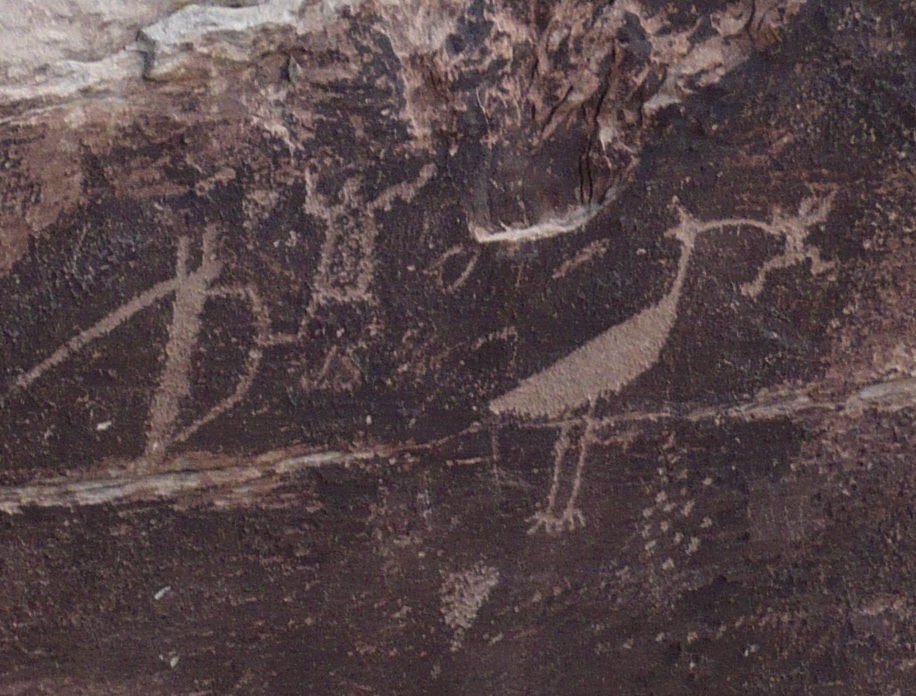
The earliest settlers built the Puerco Pueblo and carved petroglyphs.   The pueblo's mostly gone but the petroglyphs are still there, waiting for their very own photo op--probably not exactly what the Indians had intended.

Newspaper rock is a huge rock that’s covered with petroglyphs.  The first time I saw it, I was about 12 and you could actually go down stairs and look at them up close.  They lasted for 700 to 900 years without problems, but 20th century tourists didn’t do any them good at all.  Now, to protect them, the stairs are gone, and you have to view them from an overlook and hope you've got a decent telephoto lens. 


At the south end, petrified logs are scattered all over the place, jewel-toned rocks reclining on the desert floor.  These are at the Crystal Forest:
Old Faithful is the longest tree in the park:
There’s even a house made of petrified wood called the Agate House.  

It’s about a 2 mile hike from the Rainbow Forest Museum, although it used to be closer.  When George & I were there on our honeymoon in 1990, there was a parking lot nearby.  Now the old road is the “trail”:
People steal petrified wood all the time, and occasionally feel guilty about it.  The rangers told us that they get chunks mailed back all the time, but so much has been swiped over the years that the impact of all the petrified wood isn’t as strong as it once was.